What Is a Personal Statement and Who Needs One?
A personal statement is a written essay submitted as part of an application to a university, graduate programme, professional school, or competitive scholarship. It gives admissions committees a window into who you are beyond your grades and test scores — your motivations, your experiences, and your readiness for the programme you are applying to.
Almost every applicant to higher education eventually encounters the personal statement. Undergraduate applicants in the UK submit one through UCAS, where a single statement goes to up to five universities. In the US, medical, law, and business school applicants write personal statements as a core part of their application. PhD applicants write statements of purpose that outline their research interests. Even competitive internships and professional programmes increasingly ask for a short personal essay.
The common thread is this: a personal statement is your chance to speak directly to the people deciding your future. How well you use that chance can make the difference between an offer and a rejection.
What Makes a Personal Statement Strong?
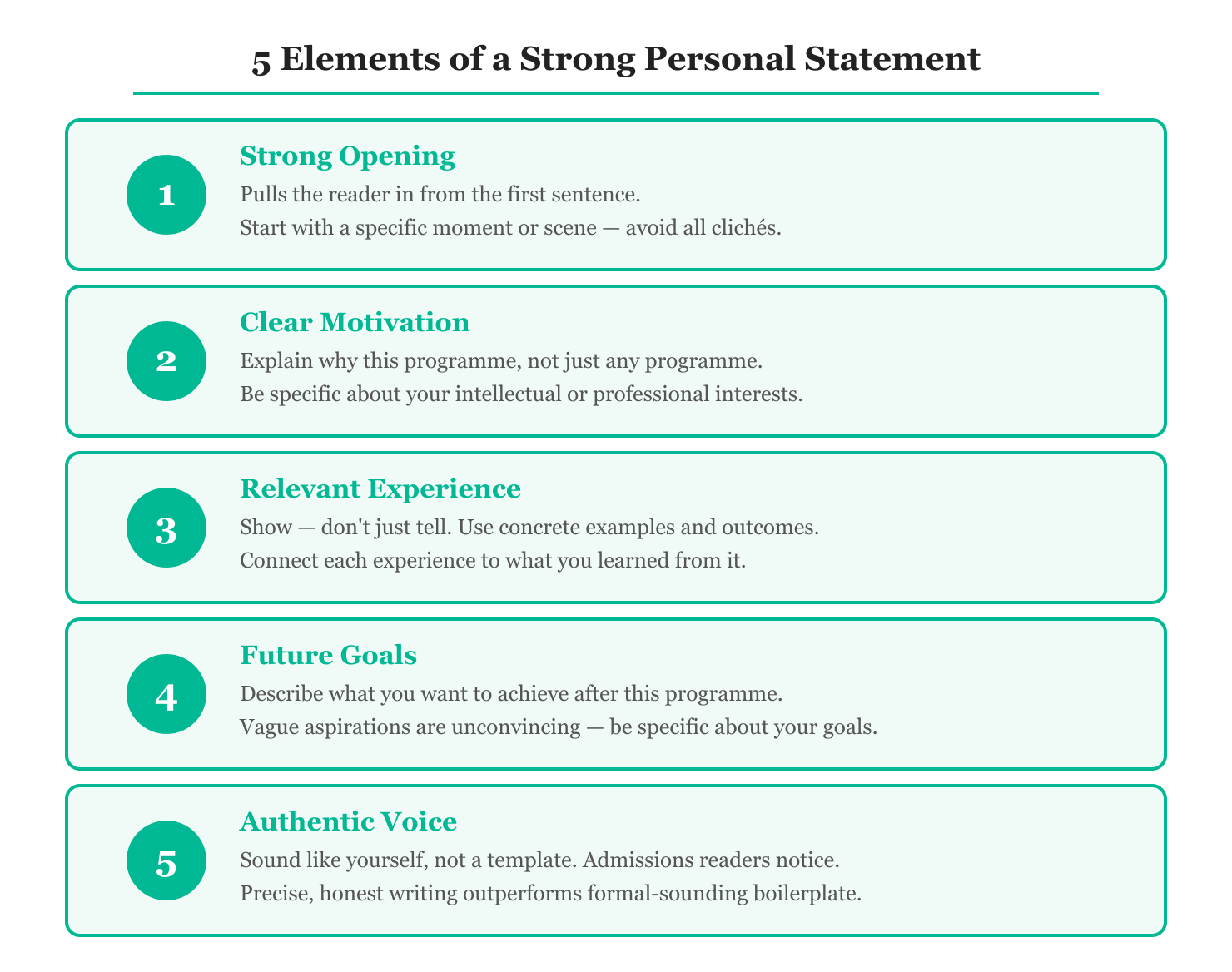
The strongest personal statements share a few qualities that separate them from the rest of the pile.
A clear and specific focus
Admissions readers see hundreds or thousands of statements each cycle. The ones that stand out have a clear central idea — a specific experience, a turning point, a research question — that anchors everything else. Vague statements that try to cover everything end up communicating nothing memorable.
Evidence over assertion
Telling the committee you are "passionate about medicine" or "a natural leader" carries very little weight. Showing them a specific moment where that passion or leadership was demonstrated carries a great deal. Strong personal statements replace adjectives with scenes, incidents, and outcomes.
A genuine voice
According to the Dartmouth College writing guide on personal statements, admissions committees are looking for the real person behind the application. Writing that sounds like it was assembled from templates or edited into impersonal formality rarely connects with readers. Your statement should sound like you — precise, honest, and confident.
Logical structure
Every paragraph should serve a clear purpose. The opening should pull the reader in. The middle should develop your theme with specific evidence. The closing should leave the reader with a clear sense of your direction and why this programme fits it. There should be no orphaned paragraphs, no sudden topic shifts, and no conclusion that simply restates what was already said.
Common Mistakes Applicants Make
Understanding what weakens a personal statement is just as important as knowing what strengthens one. These are the most common errors that undermine otherwise qualified applicants.
Clichés and overused phrases
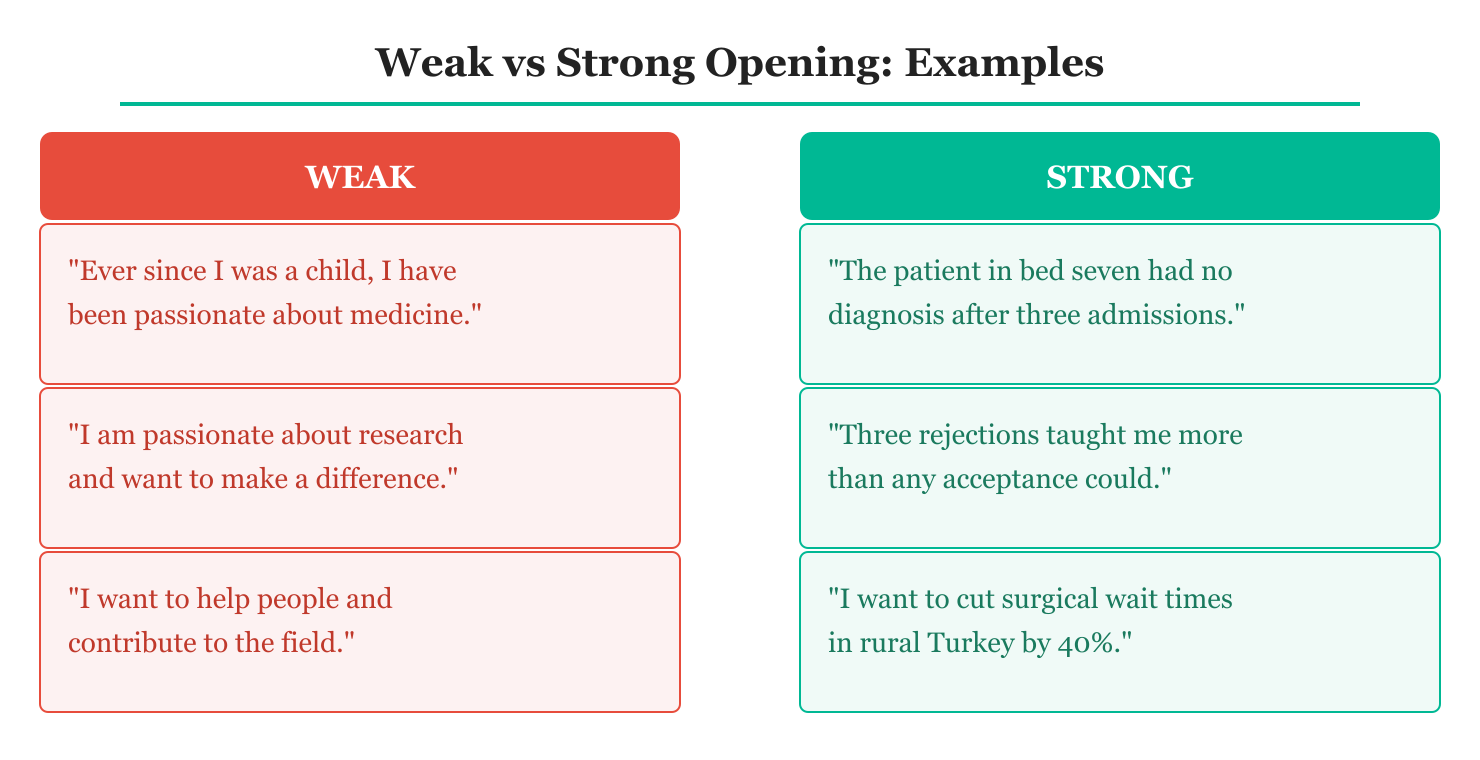
Phrases like "ever since I was a child," "I have always been passionate about," and "this experience changed my life" appear in so many statements that they have become invisible to readers. Clichés signal a lack of original thought. Replace them with precise language that reflects your actual experience and reasoning.
Repeating your CV
Your transcript, grades, and extracurricular record are already visible to the committee elsewhere in your application. A personal statement that simply narrates your achievements in prose form wastes the opportunity. The personal statement should interpret your experiences — explain what they mean, what you learned, and how they connect to what you want to do next.
Vague or unconvincing goals
Statements that describe your future plans in the broadest possible terms — "I hope to make a difference" or "I want to contribute to the field" — are unconvincing because they could apply to any applicant. Strong statements name specific research questions, professional contexts, or problems you want to work on. The more specific your goals, the more credible they appear.
Poor grammar, spelling, and structure
A personal statement with mechanical errors tells the admissions committee one of two things: you did not care enough to proofread, or you lack the writing skills required at this level. Neither interpretation helps your application. Even a single misplaced apostrophe or incorrect tense can undermine the impression an otherwise strong statement creates. Professional proofreading before submission is not optional — it is essential.
Ignoring the prompt
Many applicants write a strong essay — but not the one they were asked to write. Read every prompt carefully. If the question asks specifically about a challenge you overcame, do not pivot into a general account of your interests. Address the prompt directly and completely before adding any additional context.
How a Personal Statement Checker Can Help
Once you have drafted your statement, a personal statement checker can give you structured, objective feedback before you submit. This is particularly valuable because most applicants are too close to their own writing to see its weaknesses clearly.
A personal statement checker reviews your draft for several key dimensions:
- Clarity and coherence: Does each paragraph connect logically to the next? Is the central theme maintained throughout?
- Specificity: Are your claims supported by concrete evidence, or do they rely on vague assertions?
- Tone and voice: Does the statement sound authentic, or does it fall into over-formal or template-driven language?
- Grammar, spelling, and punctuation: Are there any mechanical errors that would distract or concern a reader?
- Compliance with word limits and format requirements: Is the statement the right length for the programme or platform you are applying to?
Using a personal statement checker does not replace your own revision process — it supplements it. The checker surfaces issues that are easy to miss when you have been working on the same document for days or weeks. Many applicants find that their strongest draft comes after at least two rounds of self-revision followed by a professional review.
Personal Statement Checklist Before You Submit
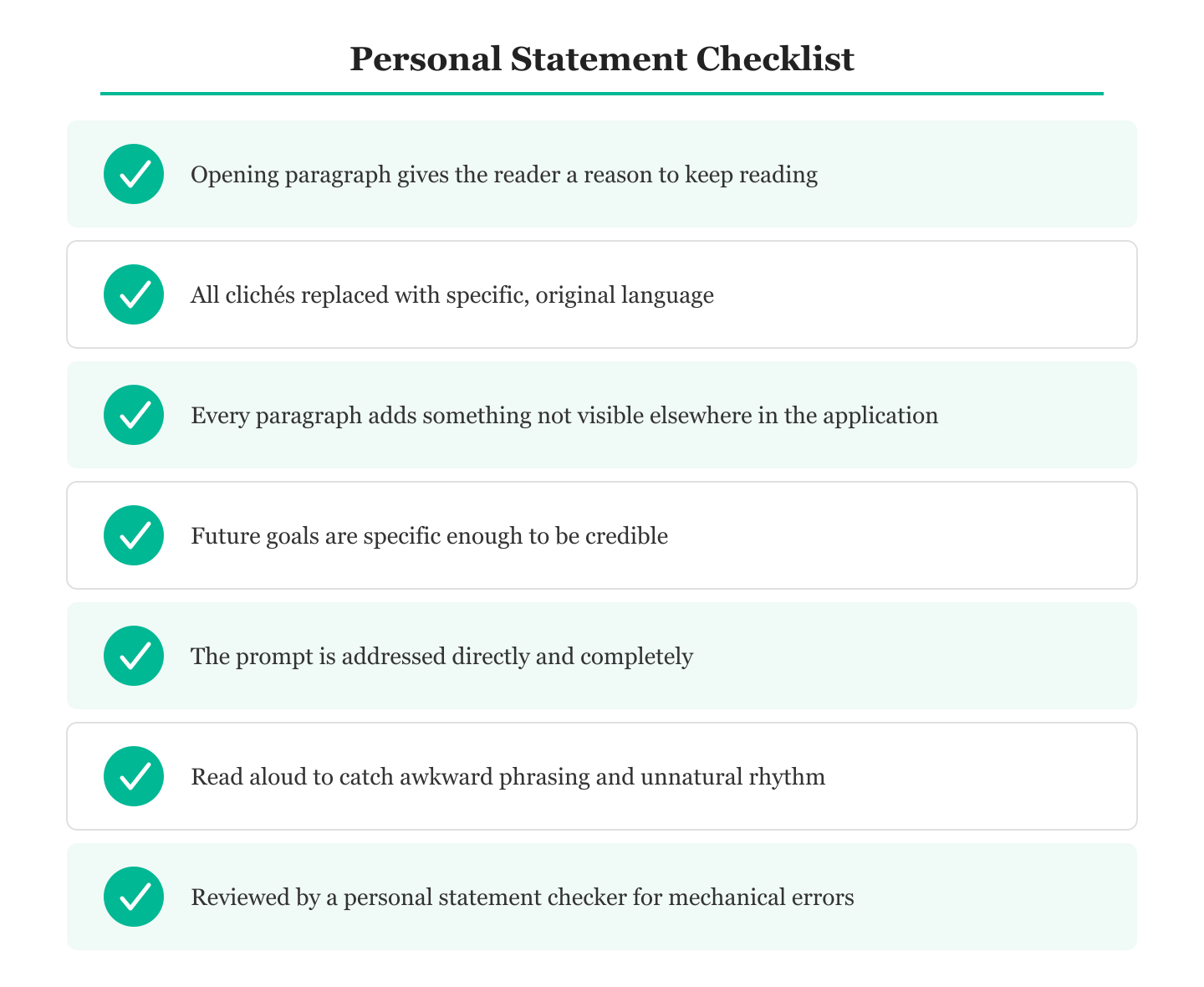
Before you finalise your personal statement, work through this checklist:
- Does your opening paragraph give the reader a reason to keep reading?
- Have you replaced all clichés with specific, original language?
- Does every paragraph add something that is not already visible elsewhere in your application?
- Are your future goals described specifically enough to be credible?
- Have you addressed the prompt directly and completely?
- Does your closing paragraph leave the reader with a clear sense of your direction?
- Have you read the statement aloud to catch awkward phrasing?
- Has someone else read it for clarity and coherence?
- Have you run it through a personal statement checker for mechanical errors?
- Is it within the required word or character limit?
Do you need an expert to review and edit your personal statement?
Have you finished drafting your personal statement? Do you want a professional to review it and make the changes needed to strengthen it before you submit? If yes, we offer the most trusted and efficient editing and proofreading services available. At Best Edit & Proof, our subject-area experts will edit and proofread your personal statement to give it the clarity, precision, and impact it needs.
Best Edit & Proof expert editors and proofreaders focus on offering documents with the proper tone, content, and structure for academic writing and also provide an upscale editing and proofreading service for you. If you consider our pieces of advice, you will witness a notable increase in the strength and impact of your personal statement.
English manuscript formatting service
You can also avail of our assistance if you are looking for editors who can format your document, or just check on the particular styles for the formatting task as per the guidelines provided to you, e.g., APA, MLA, or Chicago/Turabian styles.
Get a free quote for editing and proofreading now!
Kindly visit our order page if you want our subject-area editors or language experts to work on your personal statement. Click here to find out how it works. If you want an instant price quote, use our pricing calculator.
24/7 customer support | Live support
If you need support, contact us or use the 24/7 live chat. You can also reach us through our WhatsApp business support line.
Stay tuned for updated information about editing and proofreading services!
Follow us on Twitter, LinkedIn, Facebook, Instagram, and Medium. For more posts, click here.
To give you an opportunity to practice proofreading, we have left a few spelling, punctuation, or grammatical errors in the text. See if you can spot them! If you spot the errors correctly, you will be entitled to a 20% discount.